
Kentucky State Police at a Glance
Kentucky State Police is the state repository agency. Its Criminal Identification and Records Branch, Records Section administers criminal identification and dissemination within the Justice and Public Safety Cabinet. KSP is not part of the Kentucky Court of Justice. That split matters. KSP maintains a fingerprint-linked criminal history, while the Administrative Office of the Courts produces CourtNet summaries and each circuit court clerk maintains the official judicial file.
KRS 17.147 directs KSP to gather information for the centralized criminal history system, set procedures and security, and furnish information to authorized agencies. KRS 17.150 supplies the broader reporting framework. The agency also connects qualifying fingerprint transactions with national CJIS services. These duties make KSP the hub between arresting agencies, booking fingerprints, court dispositions, authorized Kentucky checks, and eligible FBI-supported checks.
What Checks KSP Offers
The KSP background-check page separates name-based checks from fingerprint-supported routes. Kentucky does not offer an unrestricted instant public name portal through KSP. The public name-based product requires the adult subject's permission and a completed form. Personal review is for the person named in the record. Fingerprint-supported Kentucky and FBI checks require statutory authority and the service code supplied by the requesting program.

The official product page should control whenever a form, price, location, or instruction changes. KSP also accepts written open-records requests for identifiable, releasable agency records, but that route is not a substitute for a gated criminal history product. A separate AOC CourtNet report summarizes court data from all 120 counties and is not a KSP check.
| Product | Who May Order | What It Returns | Cost or Route |
|---|---|---|---|
| Kentucky adult name-based history | Public requester with the adult subject's permission | KSP centralized Kentucky name match; no fingerprints | $20 by check or money order; mail or walk-in |
| KSP personal review | Record subject | The requester's centralized Kentucky record for review | Use current KSP 309 instructions; confirm current price |
| Kentucky and FBI fingerprint check | Person in a statutorily authorized program with a service code | Fingerprint-supported state and federal result to the authorized recipient | Program-specific IdentoGO total; local printing may add up to $10 |
| FBI personal Identity History Summary | Record subject | National fingerprint identity history | $18 direct FBI fee through EDO or mail |
| KSP open-records request | Requester subject to statutory exemptions | Identifiable releasable KSP-created records | Actual reproduction or media costs |
| AOC CourtNet report | Public requester through a different agency | Statewide judicial summary, not a signed file | Current AOC fee plus applicable card surcharge |
KSP Name Check Fields
A KSP name-based check is a form request, not an anonymous database query. The requester provides contact and mailing information. The subject's full name, aliases or maiden names, sex, race, date of birth, and Social Security number where the current form requests it help KSP distinguish records. The form also carries the subject's authorization and signature, requester certification, purpose or form selection, and payment enclosure.
The official KSP background-check form library is the right place to select the current form. Read which fields are marked mandatory on the downloaded version. Do not move sensitive identifiers into ordinary email unless the current official form expressly permits that channel.
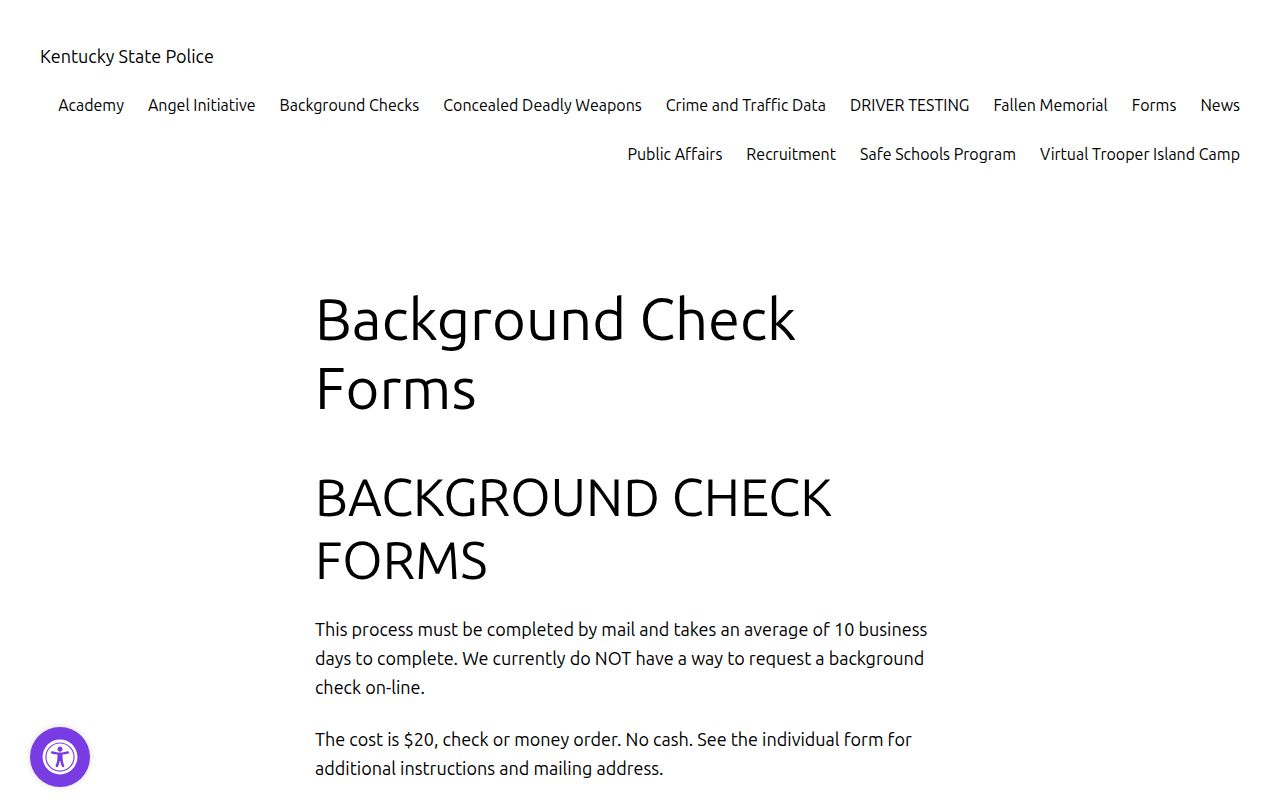
The form library shows why the product choice comes first. A general adult name request, personal review, and fingerprint program have different authority, identity, and delivery rules. Using the wrong form can delay the request or send a person toward a check that does not answer the question.
The Path Into the KSP Repository
A Kentucky criminal history begins outside KSP. An arresting sheriff, city police department, KSP trooper, or other peace officer creates the arrest or incident record. The receiving jail records the booking and captures fingerprints for qualifying arrested people before release under KRS 441.046. Uniform citations and UOR reports supply identifiers used farther along the reporting chain.
Data flow: County Arrest › Fingerprint Submission › Kentucky State Police › Court Disposition Reporting › Rap Sheet
The court process remains separate. District Court handles misdemeanors and felony preliminary matters. Circuit Court receives indictments and tries felonies. The circuit court clerk maintains both courts' files in each county. When the court resolves a charge, disposition information must return to KSP so the repository can link the outcome to the fingerprint-supported arrest cycle. The compiled rap sheet is useful statewide, but it does not become the official signed case file.
KSP UOR Reporting Chain
The Kentucky UOR reporting regulation defines the records that carry an arrest and its outcome. UOR-1 is used for felony cases and specified misdemeanor, property, or person offenses when a citation alone is not enough. It is forwarded to KSP Records. UOR-3 carries preliminary or final court dispositions for offenses involving arrests not reported only by citation.
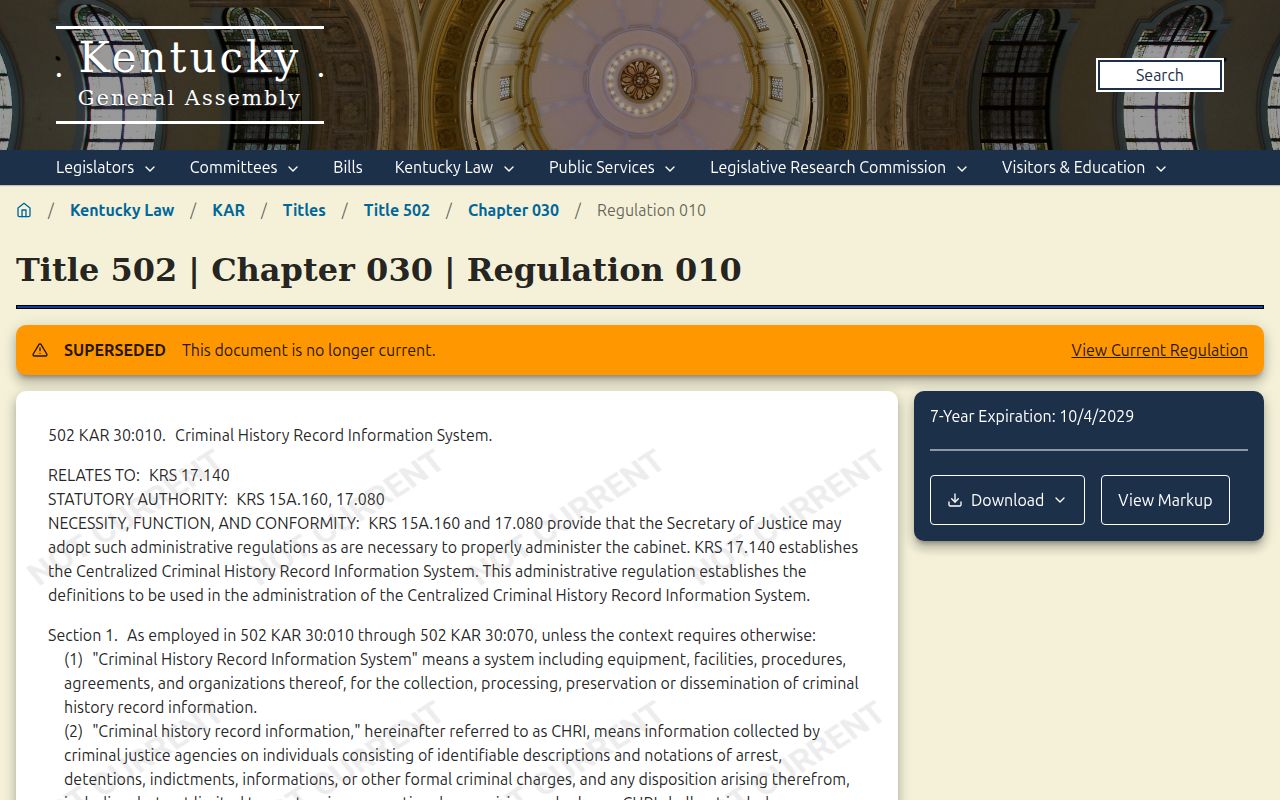
The regulation explains why matching identifiers are vital. If the disposition cannot be tied to the original arrest cycle, a KSP entry may remain open or lack its final outcome. Older paper records, late reports, amended charges, and unmatched identifiers can also cause a gap. The remedy begins with the source. Obtain the correct disposition from the filing clerk, then send the proof through the KSP review or challenge instructions.
KSP IdentoGO Fingerprint Checks
KSP uses IdentoGO by IDEMIA for fingerprint capture in statutorily authorized Kentucky and FBI programs. The authorizing agency supplies a service code. That code identifies the program, its authority, and where the result goes. A person schedules at a Kentucky enrollment location, enters the required biographical data, presents the listed identification, pays the program total, and provides fingerprints.
KCHIRP delivers the result to the authorized agency. A person generally cannot redirect that statutory program report or substitute a code from a different program. KSP does not publish one universal fingerprint total because state, FBI, and vendor components vary by service code. Local law enforcement that rolls prints may add up to $10. For self-review, use the KSP personal-review route or the FBI subject-only Identity History Summary instead of guessing a program code.
Note: Fingerprint capture confirms identity more strongly than a name match, but it does not turn a repository summary into the county's signed court file.
KSP Check Ordering Steps
Choose the channel by the record needed. A permitted Kentucky adult name check uses KSP's current form, subject permission, and mail or walk-in delivery. A personal review uses KSP's subject-review instructions. A statutory Kentucky and FBI check starts with the service code from the authorized program. An FBI-only personal summary follows the FBI's own EDO or mail process. Court case detail belongs with AOC and the filing clerk.
- Define the scope: Kentucky repository record, personal review, authorized fingerprint check, federal personal summary, or court file.
- Download the current KSP form or obtain the correct IdentoGO service code from the authorized program.
- Gather the required identity fields, signatures, permission, identification, or fingerprints for that route.
- Submit through mail, walk-in service, or the scheduled fingerprint channel and pay the exact current fee.
- Read the result by arrest cycle and disposition. Pull the county case file when an entry requires confirmation.
KSP reports an average mail processing time of 10 business days for the $20 name-based request. That is an average, not a promise for every request. Walk-in instructions and the Records Division location can change, so check the official page before travel.
KSP Criminal History Evolution
Kentucky State Police was created in 1948. Its identification role grew from fingerprint files and uniform paper reporting into the state's computerized criminal history repository. The UOR-1 and UOR-3 framework standardized how arrests and outcomes reached the Records Section. Electronic citation, live-scan fingerprint capture, CourtNet, KCHIRP delivery, and FBI CJIS exchange now operate beside that older reporting logic.
The key Kentucky feature has not changed: local agencies and courts create the source events. State systems compile or summarize them. CourtNet now spans all 120 counties and AOC reports felony coverage back to 1978, yet the signed judicial file remains with the local clerk. KSP can connect a fingerprint-supported arrest and reported outcome statewide, but it still depends on complete reporting from the agency and court that handled the event.
Comparing KSP and County Records
A KSP criminal history is the stronger first choice when the aim is a centralized Kentucky arrest-and-disposition view tied to repository identity data. County records are stronger when the aim is the newest booking entry, charging document, docket event, signed judgment, or certified copy. Neither replaces the other. Route the local half of a review through Browse Counties and contact the agency or circuit court clerk that created the disputed item.
| Question | KSP Check | County Record |
|---|---|---|
| Coverage | Centralized Kentucky criminal history | One county, agency, jail, or court file |
| Identity | Fingerprint-supported cycles or name-based matching by product | Local identifiers and case or booking numbers |
| Freshness | Depends on agency and court reporting | Often changes as the booking or case moves |
| Detail | Rap-sheet arrest and disposition summary | Reports, docket entries, filings, orders, and certified copies |
| Best use | Statewide personal review or official KSP product | Confirming the source event and full case context |
KSP Open Records Boundary
An open-records request asks KSP for an identifiable releasable record the agency holds. It does not bypass criminal history dissemination rules. Use KSP's written open-records channel for administrative, incident, or other nongated records within the agency's custody. The KSP open-records request page provides the current custodian routes for mail, email, fax, and hand delivery.
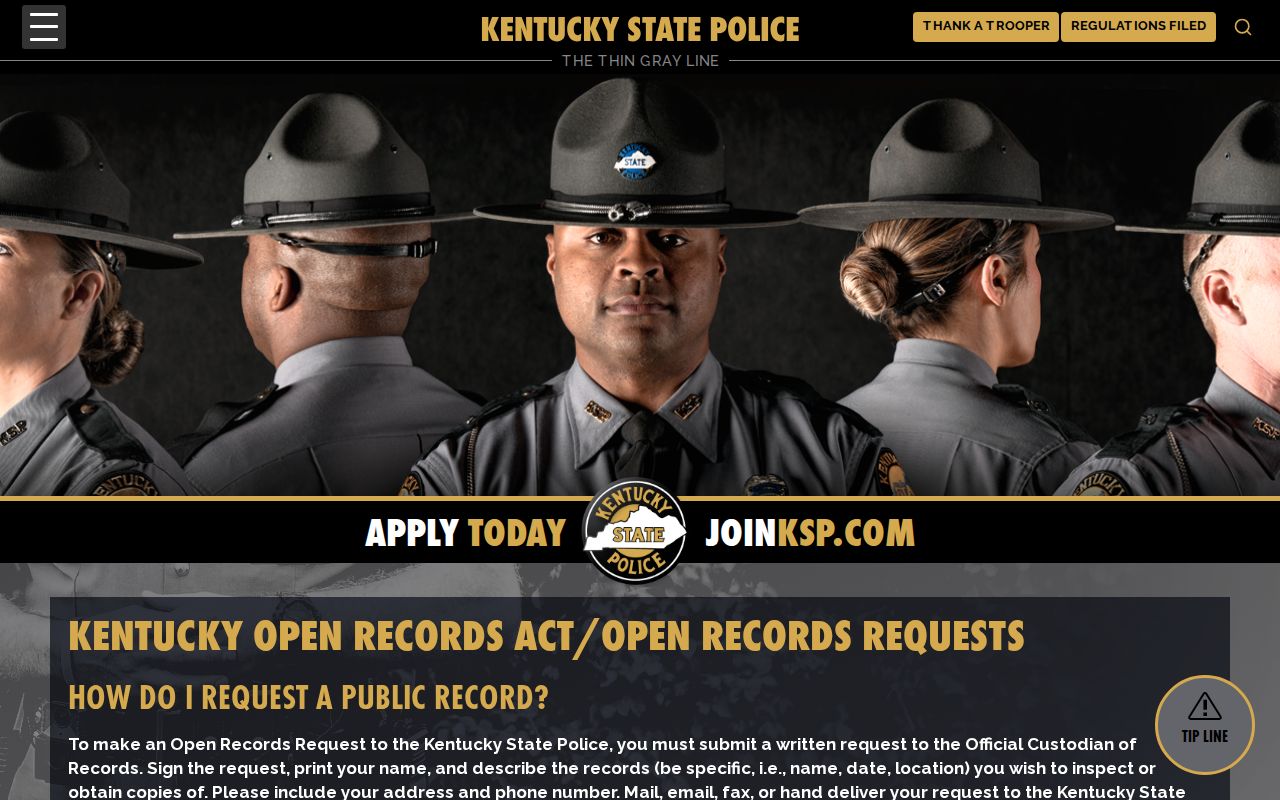
The request page keeps the Kentucky Open Records Act route separate from KSP's named criminal history products. Ask for a reasonably described record and expect statutory exemptions or reproduction costs where applicable. If the desired item is a court judgment, send the request to the filing clerk. If it is a booking record, contact the responsible jail or arresting agency. Custody of the record controls the route.
Why KSP and CourtNet Differ
KSP and CourtNet can show different facts without either system answering the same question incorrectly. KSP is organized around centralized criminal history and fingerprint-linked arrest cycles. CourtNet is a judiciary summary of clerk-entered cases. A court event may appear before its disposition reaches KSP. An older KSP arrest may lack a matched final outcome. CourtNet may show a proceeding that never produced a fingerprint-supported arrest cycle.
Compare the arrest date, county, case number, charge, amendment, and disposition date. Then retrieve the signed order from the circuit court clerk. AOC describes its own report as “Not an Official Court Record.” If the court summary itself is wrong, begin with the AOC Records Unit at 800-928-6381; some corrections must be made by the county clerk. If the KSP rap sheet is wrong, use personal review and the KSP correction process.
KSP Record Error Corrections
Correction begins with a copy of one's own KSP record. Identify the exact arrest cycle, charge, disposition, State Identification number, transaction number, or biographical field that appears wrong. A missing dismissal needs more than a verbal account. Obtain a certified copy of the correcting order or final disposition from the circuit court clerk in the county of origin.
- Request a personal KSP criminal history review through the current KSP 309 or Records Branch instructions.
- Mark the exact line believed wrong and compare it with the official local arrest and court records.
- Obtain a certified correcting order or disposition from the circuit court clerk when the error comes from the case outcome, then submit that proof to KSP Records under its current challenge instructions.
- Order a fresh official copy after processing and confirm that the arrest cycle and disposition now agree.
Expungement also requires coordinated updates. The clerk distributes an expungement order to KSP, the arresting agency, jail, prosecutor, and other named agencies, while KSP handles notice to appropriate federal recipients. A person should identify any other affected agency within the required process. Rechecking each source confirms whether the change reached all systems.