
How Kentucky Courts Handle Criminal Cases
Kentucky divides trial-level criminal work between District Court and Circuit Court. District Court hears misdemeanors, violations, traffic matters, juvenile cases, and the early stages of felony complaints. It conducts felony preliminary hearings. Circuit Court has general jurisdiction over felonies and capital offenses, receives grand-jury indictments, and hears eligible appeals from District Court. An appeal from Circuit Court usually proceeds to the Kentucky Court of Appeals. The Kentucky Supreme Court is the final state court, subject to the rules for direct review.
The elected circuit court clerk serves both Kentucky trial courts in each county. That office keeps the official Kentucky court case file. The Kentucky Administrative Office of the Courts, or AOC, collects clerk-entered case information in CourtNet. This split matters. CourtNet and a Kentucky AOC report can point to a case, yet neither replaces the signed indictment, judgment, order, or certified docket held by the county clerk.
Kentucky Criminal Court Jurisdiction
A Kentucky case can touch both trial courts without being duplicated. A felony allegation may begin as a complaint in Kentucky District Court. After a preliminary hearing or grand-jury action, a Kentucky Circuit Court criminal case can follow. Misdemeanor and traffic matters normally remain in District Court. The Kentucky case type and court division are thus useful routing clues, not mere abbreviations.
| Kentucky court | Criminal work | Likely next source |
|---|---|---|
| District Court | Misdemeanors, violations, traffic, and felony preliminary matters | District file or Circuit Court after felony transfer or indictment |
| Circuit Court | Felonies, capital offenses, indictments, and eligible District appeals | Circuit clerk file, then appellate docket if reviewed |
| Court of Appeals | Most appellate review | Kentucky Supreme Court when further review is allowed |
| Supreme Court | Final Kentucky review and specified direct appeals | Federal review only when a federal issue remains |
Running a CourtNet 2.0 Search
Kentucky does not provide a fully open, anonymous statewide docket with every filed document. Kentucky CourtNet 2.0 offers detailed authenticated access by role. The public Kentucky paths are AOCFastCheck and One-Time Request, which order criminal-record reports from CourtNet data in all 120 counties. Registered Kentucky FastCheck users retrieve results online. A one-time result arrives by U.S. mail. Kentucky requests are processed in order and have no expedited tier.
The AOC public menu shows the two ordering routes:
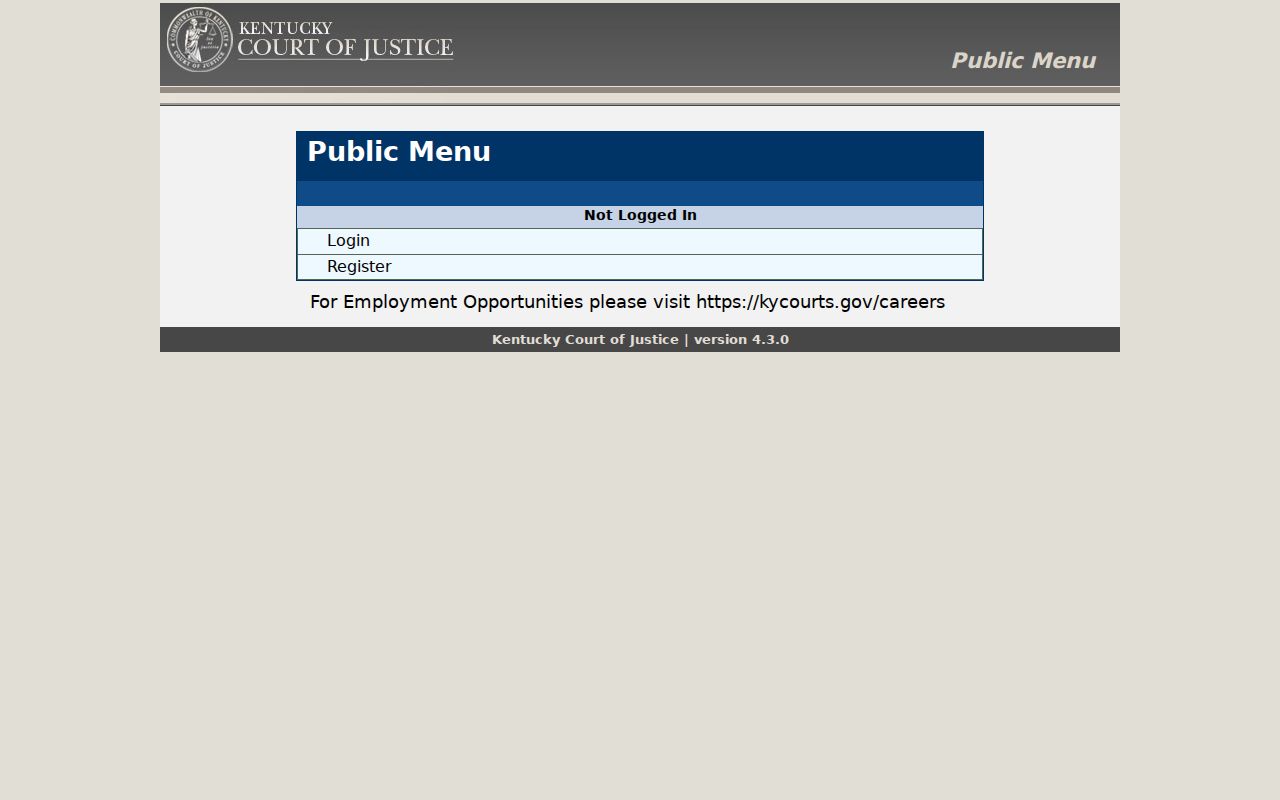
The menu helps a reader choose registered online delivery or a mailed one-time report before entering case-subject details.
- Choose registered FastCheck or One-Time Request based on the needed delivery method.
- Enter the requester details and the subject's full legal name. Add date of birth and other requested identifiers to reduce common-name matches.
- Submit payment through the official channel. Registered users can watch the processing status.
- Record the Kentucky county, case number, case type, charge dates, and disposition shown in the result.
- Ask the circuit court clerk in the filing county for the docket sheet, charging instrument, final judgment, sentence, or a certified copy.
| Input or control | Type | Required | Use |
|---|---|---|---|
| FastCheck or One-Time | Route selection | Yes | Sets online or mailed delivery |
| Requester contact and address | Text | Yes | Supports the account, order, and delivery |
| First, middle, and last name | Text | As marked | Use the complete legal name |
| Date of birth | Date | Expected identifier | Helps separate people with similar names |
| Other identity fields | Secure fields | Conditional | Supply only through the official form |
| Payment card | Payment | Yes online | The portal accepts listed major cards and most debit cards |
Kentucky AOC Report Coverage
Kentucky AOC reports span CourtNet information from every county. They cover Kentucky traffic T, misdemeanor M, felony F, and Circuit Court criminal CR case types. Kentucky felony data reaches back to 1978. Misdemeanor and traffic coverage extends at least five years. The Kentucky report can show the county of origin, case number, original and amended charges, charge and disposition dates, outcome, and clerk-entered memos.
The Kentucky Court of Justice background-check resource displays the report fields and access rules:
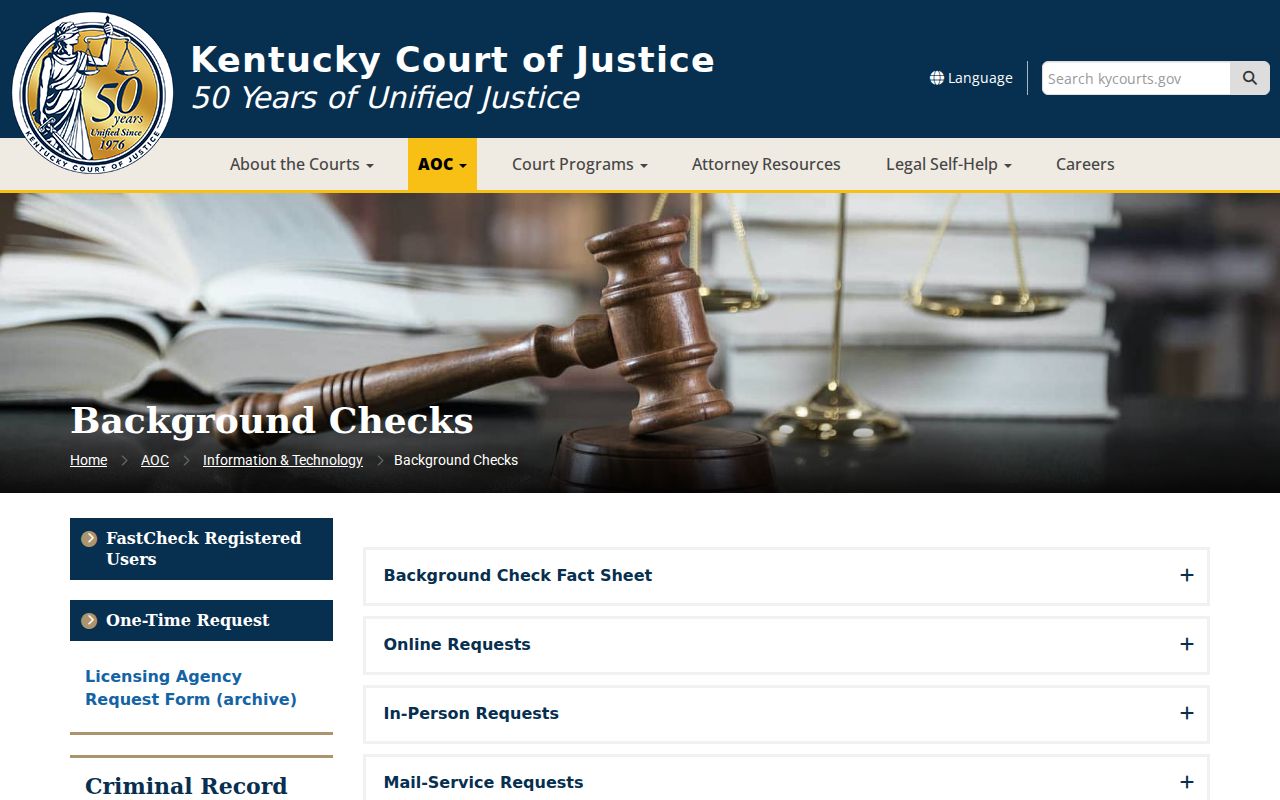
Those fields make the report a strong statewide locator, while its limits show why document research continues with the clerk.
Confidential juvenile, mental-health, and domestic-violence case types are excluded. Federal cases are outside CourtNet. If a request for another person finds a record, the AOC Records Unit notifies the subject and provides a copy. Registered results remain downloadable for 30 days, but one-time request status is not available online.
What a Kentucky Case File Contains
The Kentucky county case file records what the court received and ordered. A Kentucky CourtNet summary supplies core index facts, but the source file may contain the signed charging document, motion history, docket entries, judgment, and sentence. Kentucky availability depends on confidentiality rules and the age or format of the record. Older Kentucky material may require inspection through the clerk or archives.
| Case Number & Court | Identifies the filing county, division, case type, and individual proceeding. |
|---|---|
| Charging Documents | State the allegations placed before the court; an allegation is not proof of guilt. |
| Docket Entries | Chronicle filings, appearances, orders, and other clerk-recorded events. |
| Hearing Dates | Show scheduled or completed proceedings, subject to later court changes. |
| Disposition | Records whether a charge ended by conviction, dismissal, acquittal, diversion, amendment, or another result. |
| Sentence & Judgment | Provides the signed court outcome and penalty after a conviction. |
Kentucky Court Summary Limits
A Kentucky AOC criminal-record report bears the warning “Not an Official Court Record.” The phrase does not mean Kentucky CourtNet is useless. It means the Kentucky report is a compiled summary, not the clerk's signed case file. It may omit the full docket event list, exhibits, judge signatures, detailed financial records, and complete copies of charging or sentencing documents.
If a summary appears wrong, first confirm the county and case number. Ask that county's circuit court clerk to verify the docket and disposition. AOC Records can address CourtNet report questions, while a fingerprint-linked repository error belongs with Kentucky State Police. This source-based approach avoids asking one agency to change a record created by another.
Kentucky Criminal Case Stages
A Kentucky criminal case produces different records as it moves. Kentucky charges begin the judicial file. Arraignment formally presents them and records a plea. Kentucky pretrial work can add motions, orders, bond terms, and hearing entries. A plea or trial leads toward a Kentucky disposition. A conviction then produces a Kentucky judgment and sentence. Dismissal, acquittal, or diversion may create a very different Kentucky final entry.
Case flow: Charges Filed › Arraignment › Pretrial › Plea or Trial › Disposition › Sentencing
A felony may also shift from a District Court complaint to a Circuit Court CR case after indictment. Readers should trace the case number and court division, not assume every early entry remains under one docket. The final disposition is vital because an arrest or charge alone does not show how the court resolved the allegation.
Reading Kentucky Criminal Case Outcomes
Kentucky case terms carry distinct meanings. A Kentucky conviction is a judgment of guilt after a plea or adjudication. An acquittal is a not-guilty result after adjudication. A dismissal ends the charge without a conviction; dismissal with prejudice bars refiling of that charge. Kentucky pretrial diversion is a supervised chance to obtain dismissal after meeting conditions and is not the same as a conviction.
- Disposition
- The recorded way a charge or case ended.
- Nolle prosequi
- A prosecutor's decision not to continue a charge at that time.
- Indictment
- A grand jury's formal felony accusation, not proof of guilt.
- Arraignment
- The hearing where charges are formally presented and a plea is entered.
- Grand jury no true bill
- A decision not to indict, which differs from a trial acquittal.
Note: Read each Kentucky charge row separately because amended charges in one case can end with different dispositions.
Turning Kentucky Summaries Into Files
Once the Kentucky statewide report identifies a case, capture its county, full number, court, and charge rows. Contact the Kentucky circuit court clerk in that county. Ask for the Kentucky docket sheet and name the exact documents needed, such as the charging instrument, final judgment, order, and sentence. Also ask whether plain or certified copies are required and whether the Kentucky clerk offers remote delivery.
The Kentucky Open Records Act applies to nonexempt public-agency records, but Court of Justice case records follow judicial access rules. An administrative open-records form is not a substitute for a clerk request for the court file. The Kentucky Attorney General's open-records materials explain the public-agency request and appeal framework:
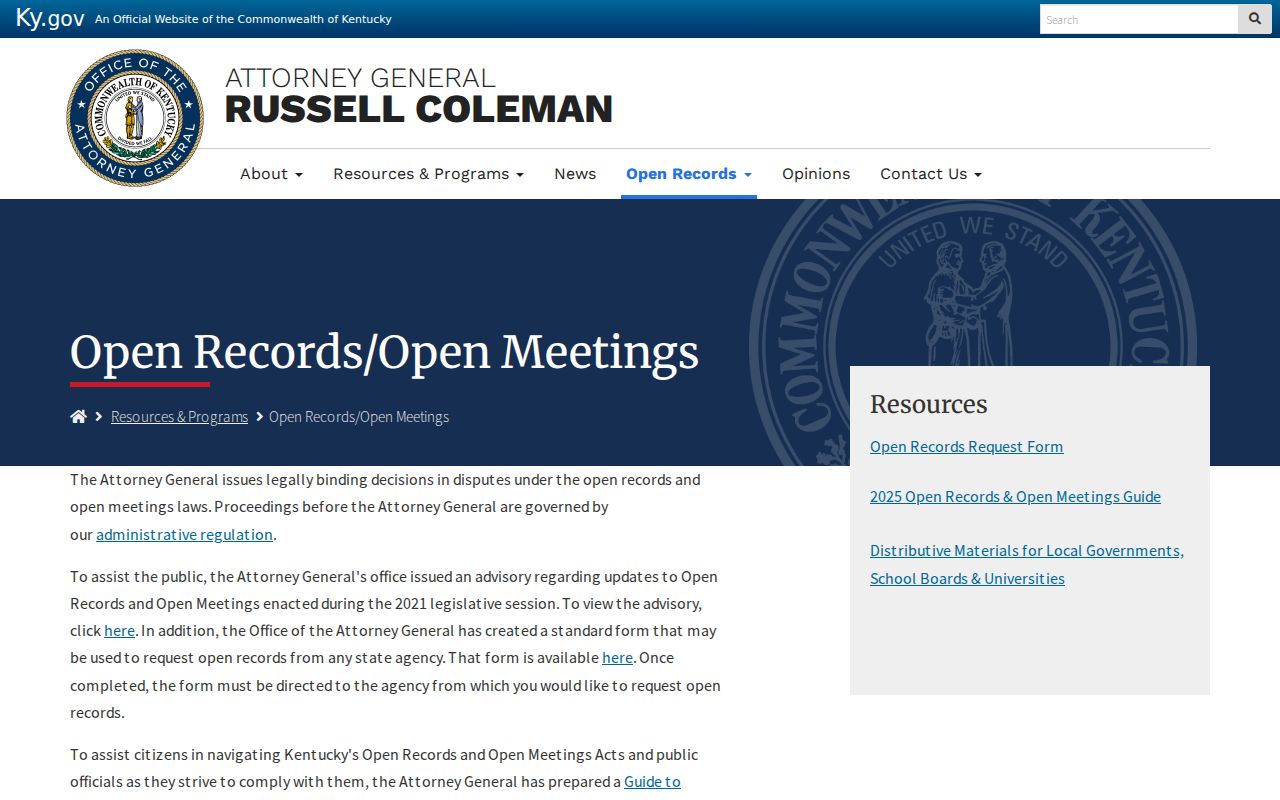
The guidance helps distinguish an agency-record request from the judicial route used to obtain a filed criminal case document.
County Sources for Kentucky Case Records
The complete Kentucky criminal case file sits with the circuit court clerk in the filing county. County access can differ for remote copies, archives, local schedules, and copying costs. Search statewide first when the county is unknown. Then route the document request to the clerk that holds the case. For an appealed matter, also check the Kentucky appellate courts. For a federal prosecution, use PACER instead of CourtNet.
Browse the directory of all 120 Kentucky counties to reach the local criminal-records route for the right clerk. The same county path helps reconcile a late disposition or locate documents that do not appear in an AOC summary.
Note: A county clerk's signed Kentucky court record controls when a statewide summary and the official file do not match.